Tips

Many kinds of flower are collected Here, Besides, do you need flower in your wedding or match with your ball dresses nz?

Sunday, February 25, 2018

WTHBA Announces 2018 Home and Garden Show

The event will take place at the Lubbock Memorial Civic Center, Friday, March 2 (4-8 pm), Saturday, March 3 (9 am - 6 pm ), concluding Sunday, March 4 (12-6 pm.) Tickets are available at the door - $5 for adults and $2 for children ages 12 and under. A portion of the proceeds will benefit Lubbock Homes for Heroes.

This year's show will feature over 100 various vendors with booths on display showcasing the latest trends in the home and garden industries.

While there, event goers can register to win one of these fantastic prizes with a total value exceeding $7,000: RO system sponsored by Kinetico of West Texas, solar shades from Budget Blinds, $1,000 paint job from CertaPro Painters, insulated garage door from Overhead Door, two seasonal ceramic planters from Lubbock Designscapes, and a custom patio shade from Beat the Heat shading systems.

Be sure and sign the kids up for the always fun LegoTM Home Building Contest sponsored by Betenbough Homes. And making its debut this year is a coloring table for the kids with themed opportunities for them to feel right at home. Encouraging fun for the whole family, we invite children ages 6-10 to sign up to compete for prizes Saturday 11 am - 12 pm and 3-4 pm, as well as Sunday from 2-3pm.

"We are thrilled to host this event, having the opportunity to feature some of Lubbock's finest home and landscaping experts," commented West Texas Home Builders Association Executive Director, Gena Godinez. "We can't wait to unveil new ideas for your home that you'll flip for! Our members and vendors have prepared year round to showcase valuable talents and products that can help you achieve the home of your dreams. We look forward to seeing you there!"

Friday, January 26, 2018

Attract Wealth and Prosperity with a Money Plant

If you'd like to attract more wealth and prosperity into your home or office, adding a money plant can be a great solution. These beautiful plants are actually quite easy to grow, requiring only an average amount of light and water. Although commonly referred to as a money plant or money tree, the botanical name of this plant is actually Pachira. You'll often find small Pachira plants for offered for sale in nurseries and through online sources. However, with care and time these plants can become quite large, often reaching a size of three feet wide and seven feet tall.

The shape of the Pachira leaves is one of the reasons why it is referred to as a "money plant" or "money tree." When placed around your home or yard, it can help balance any of the missing feng shui elements, thus creating a more harmonious environment. Since this plant is symbolic of wealth and prosperity, it is a popular addition to both homes and offices.

Although you could certainly enjoy the beauty of one of these plants anywhere in your home, strategic placement is important if you want to attract wealth and prosperity. When choosing a location, look for areas that are symbolic of money. For example, if you wanted to attract more wealth to your business, you might want to display one of these plants close to your cash register, sales department or accounting department. In your home, you could use a money plant to attract more wealth to your home business by placing it in your office. If you work in an office or cubicle, place one near your desk to symbolize the wealth-producing possibilities of your work.


Although you might not have ever heard of a Pachira plant before, they are actually an easy plant to find and grow. If you aren't able to locate one at your local plant nursery, an online search should make it easy to find stores that sell them. Pachira plants require only average soil, and should be watered the same as most house plants. They do best with an average amount of sunlight. Although these plants probably would not thrive in corners of your home that do not receive much light, they are perfectly suitable for most other areas. Because they eventually grow quite large, they work well as part of a floor plant display or as a single specimen planting.

Wednesday, December 27, 2017

Hotel Flower Garden


This property is 2 minutes walk from the beach. Hotel Flower Garden houses an outdoor pool, a spa and a gym. Offering free Wi-Fi access, it features chalet-style cabanas set in a tropical garden.
Flower garden / Цветочный сад. Комментарии : LiveInternet - Российский Сервис Онлайн-Дневников

The property is about 3.7 miles from central Galle and an hour’s drive from Colombo.

Fitted with a private balcony and a four-poster bed, Flower Garden’s accommodation is air-conditioned, and features a flat-screen TV and an en suite bathroom with hot/cold water supply, toiletries and a hairdryer. Tea/coffee making facilities and a minibar are included.

The restaurant serves a variety of local and international delights, and specialises in seafood dishes. Room service is provided.

Guests can make travel arrangements at the tour desk, or head to the 24-hour front desk for assistance with airport shuttle, laundry and ironing services. Safety deposit boxes are also available.

Monday, November 27, 2017

New disease on apple trees

Spots and discoloration on the leaves of apple trees and premature leaf fall are caused by various pathogens. Most of these are apple scab or leaf spot diseases caused by fungi of the genus Phyllosticta . In recent years, home gardening and organic farming has more often seen a premature leaf fall in which the leaves had similar symptoms. According to investigations by the Bavarian State Research Center for Agriculture, however, the causative agent in these cases was not one of the known domestic pathogens, but the fungus Marssonina coronaria.


After a summer of frequent rainfall, the first spots may form on the leaves as early as July. They later converge and larger leaf areas turn chlorotically yellow. Also striking is an early onset of leaf fall, often in the summer. The fruits remain basically free from attack, but the leaf fall leads to a reduced fruit size and quality. The shelf life of apples is limited. In addition, next year is expected to lower flowering and fruiting.

The symptoms of fungal disease vary from species to variety. The leaves of 'Golden Delicious' show distinct necrotic grains, in 'Boskoop' the leaves are yellow in color and speckled with green dots. Idared, on the other hand, shows few symptoms. Interestingly, the strain 'Topaz' is particularly vulnerable, although it is quite resistant to apple scab, for example.

The home of Marssonina coronaria is Southeast Asia. The fungus can, like the well-known apple scab, overwinter on a fall foliage and the fungal spores infect the fully developed leaves after the apple blossom. Temperatures over 20 degrees and permanently damp leaves favor the infection - therefore the infestation pressure is particularly high in rainy years. Due to the possible climate change with increasingly humid summers, a further spread is likely, especially in home gardens, organic apple orchards and orchards.


Because the mushroom (Marssonina) overwinters during fall foliage, you should carefully collect it and promote a loose crown structure through regular fruit tree trimming, so that the leaves can dry well during the growing season. Fighting in the home garden with fungicides does not make sense, since the starting point for the hobby gardener is difficult to recognize and repeated spraying would be necessary for a sufficient effect. In conventional fruit growing, the disease is usually combated by the preventive scab treatments.

Monday, October 30, 2017

Pittsburgh-based botanical garden adds vertical garden display for visitors

The Phipps Conservatory and Botanical Gardens, based in Pittsburgh, Pennsylvania, has utilized LiveWall’s green wall system to showcase the possibilities of vertical gardening.

The conservatory was founded in 1893 and has served as a leader in sustainability, conservation and green building design among public gardens.

Phipps strives to promote human and environmental well-being and one of the latest methods it has been pursuing is the support of growing local produce in urban areas. The botanical garden offers various programs to youth and adults on the benefits of raised bed vegetable gardening, local food production and healthy eating.

“Limited space is a significant challenge for urban gardening,” said Michael Bechtel, display horticulturist for Phipps Conservatory and Botanical Gardens. “With our green walls, we have the opportunity to study, evaluate and learn about growing edibles on space-efficient vertical gardens. This forward-thinking approach enables Phipps to offer education and assistance to homeowners, schools, and community organizations on planning, installing, and maintaining their own green walls so that they can benefit from fresh produce.”

Phipps sponsors Homegrown, its outreach program that increases community access to fresh produce and since 2013 it has helped establish more than 200 vegetable gardens in urban areas.

In 2015, the botanical garden tested out LiveWall Inspire Living Wall Panels along with several other living wall systems on its south facing wall of the Production Greenhouse Facility. After the initial testing was complete, Phipps installed nine more Inspire panels.

LiveWall was chosen thanks to its soil volume and depth for growing, its integrated irrigation system and durability, according to Bechtel. The Inspire standard panels are four feet wide and seven feet, four inches tall. Each has 24 modular planting boxes.

“Green walls, also known as living walls, are structural and horticultural systems that attach to existing walls and transform them into vertical gardens,” said Dave MacKenzie, president of LiveWall. “Growing vegetables and herbs on its green wall display is an innovative way for Phipps to demonstrate how families and community groups can grow their own fresh, healthy produce even if they do not have areas for large garden plots.”


The vertical wall display will feature beets, carrots, collard greens, kale and kohlrabi growing in the spring and in the summer, it will include basil, rosemary, thyme, celery root and various peppers.

Thursday, September 28, 2017

Montreal’s Chinese Gardens re-open after 3 years

For the past three years, the Chinese Gardens at the Botanical Garden have been getting a big face-lift.

On Thursday, the largest Chinese gardens outside of Asia were ready to show off their new shine for their official opening Friday.

Its seven pavilions were restored to their old splendor, just like they were when they opened back in 1991.

The intricate roof tiles were carefully refinished by specialized workers from Shanghai. Montreal craftsmen assisted in the job.

Their collaborative work showcases the friendship between the two sister cities, a constant theme throughout the garden.

“It was very emotional to have these two cultures -Chinese and Canadian Montrealers- come together and rebuild this magnificent garden cause it’s one of most popular gardens, the Botanical Gardens,” Charles-Mathieu Brunelle, Space For Life’s Director, told Global News.

Monday, August 28, 2017

Nick Faldo confirms for Bear Mountain golf tourney

To Sir with love, from Bear Mountain.
Sir Nick Faldo, England’s greatest golfer and knighted by Queen Elizabeth in 2009, is the latest competitor to confirm he will play in the Pacific Links Bear Mountain Championship from Sept. 11-17.
Faldo’s impressive list of accomplishments includes three Masters championships and three British Open titles for six majors in total. The unflappable six-foot-three native of Hertfordshire also won nine times on the PGA Tour and 30 times on the European Tour.
The 60-year-old is still receiving exposure as a commentator for the Golf Channel and CBS.

“Sir Nick is a true golf legend . . . he is an impactful addition to an already strong field,” said Pacific Links International president Rudy Anderson, in a statement. Announced last week for the Bear Mountain tournament was John Daly, among the most bombastic figures in golf history.
The $1.8 million US stop on the PGA Tour Champions, which is for players 50 and over, is in its second year. Colin Montgomerie from Scotland outlasted Scott McCarron in extra holes to win the inaugural Pacific Links Bear Mountain tournament last year.
Confirmed for this year’s tournament are Faldo, Daly, Montgomerie, Charles Schwab money leader Bernhard Langer of Germany, Canadian Golf Hall of Famer Stephen Ames, and former PGA Tour regulars such as McCarron, Mark Calcavecchia, Fred Funk, Jay Haas and Paul Goydos.

Monday, July 24, 2017

Who is denying global warming?

Recently, the "New York Times" published an article entitled "This is not what you imagine: the summer is getting hot" article. NASA retired climate scientist, Columbia University professor James Hansen (James Hansen) of a study shows that since the 1950s, the summer temperature gradually tend to be extremely hot.

Hansen and his two colleagues obtained a fixed baseline mean by comparing the actual summer temperatures for each decade since the 1980s. On the basis of this, from 1951 to 1980, one-third of the summer in the northern hemisphere was considered "normal", one third was "cold" and one third was "hot". After 1980, summer temperatures drastically changed, between 2005 and 2015, two-thirds of the year fell into "hot", and 15% went into a new district: "extremely hot".

Nevertheless, global warming is still a controversial topic. Last week, Project Syndicate released the article "Uncovering the Mask for Closer of Climate Change", author Benjamin Franta, a former researcher at the Harvard Institute of Science and International Affairs at Kennedy College, Harvard University, currently at Stanford University A Ph.D. degree in scientific history, dedicated to environmental policy and scientific manipulation of the study. He pointed out that 25 years after the United Nations Framework Convention on Climate Change in 1992, the world still did not establish an agreement to deal effectively with global warming, and President Trump also allowed the United States to withdraw from the Paris Agreement, Causing the power of procrastination.

Saturday, June 17, 2017

Art exhibition adds splash of colour Helmsley Walled Garden

ARTISTS Connie Fairweather and Margaret Rivers are contributing to the colour of the Orchid House at Helmsley Walled Garden with a staging of their paintings inspired by nature.
The exhibition runs until Sunday and can be viewed by visitors to the garden every day from 10am to 5pm.
Connie and Margaret, both from Ripon, take their inspiration from the natural world.
Connie, who trained at York School of Art in the 1960s, focuses on the wealth of beauty to be found in nature and works in several different mediums to explore and develop her ideas.
Margaret is a self-taught artist who started producing pen and ink drawings of botanical specimens to go towards a native flora when she was living in Sierra Leone.
On her return to the UK, she took a range of short courses, including a course on botanical illustration at the University of Sheffield. Both have exhibited in various locations around the region, but this is their first time exhibiting at Helmsley Walled Garden.
Tricia Harris, marketing manager, said: “We are so pleased to be able to exhibit the work of Connie Fairweather and Margaret Rivers in the wonderful setting of the Orchid House, a restored Victorian glasshouse.
“Their work, exploring themes in nature complements the Garden and the beauty to be found inside its walls. “We hope visitors will enjoy the exhibition and perhaps take a picture home as a souvenir of their visit.”

Wednesday, May 24, 2017

Why won’t Fuji apple tree bear fruit?


There are a variety of possible reasons why your Fuji apple tree is failing to bear fruit, including pruning techniques, variety and pollination.

If the tree has never bloomed, you may be pruning too severely. Most fruit trees require the development of spurs or short shoots on which flowers will form. It is important not to cut off all of the 1-year-old growth.

Allow dappled light to enter throughout the tree by thinning out crowded growth. Lack of sunlight can also prevent flowering and fruit set. In addition, avoid excessive heading cuts, especially during the dormant season, since heading encourages vigorous growth and reduces flower development.

If the tree has bloomed but has never set fruit, it may not be a Fuji or may need to have an additional pollinizer placed nearby to encourage bees and pollination. Although the Fuji cultivar should be "self-fruitful," meaning that it should not require cross-pollination from another apple cultivar to set fruit, it may be possible that the tree just needs additional help. Because it did have one instance of bearing fruit, perhaps a nearby apple cultivar in a neighbor’s yard helped with cross-pollination.

If the tree is not a Fuji or "self-fruitful," it will require a pollinizer (a tree or branch of a different apple variety with a similar bloom period) planted nearby (no further than 35 to 50 feet away). If there is no room to plant an additional tree, a pollinizer variety could be grafted onto the existing tree.

To test this solution, try placing flowering branches of a different pollinizer variety in a jar filled with water and set the jar in the tree canopy. Bees will visit these flowers and cross pollinate the existing tree.

When choosing a cultivar for cross-pollination, be sure that the bloom times overlap with the existing tree.

If the tree has bloomed and set fruit normally but the fruit dropped off prematurely, a variety of other factors could be causing poor fruit set, including the weather. During bloom time, strong winds and cold temperatures can greatly reduce or prevent adequate bee activity. Frost during or shortly after blooming can cause young fruitlets to abort even though no frost damage is seen.

Too much or too little water during the summer can cause fruit to drop. Drooping or yellowing leaves would indicate improper irrigation.

In addition, backyard fruit trees do not require heavy applications of fertilizer. Too much nitrogen will cause excessive new growth, which will shade out branches and cause poorer fruit set.

Depending on where the tree is located, it may be receiving too much shade from nearby trees or buildings or is competing for nutrients from other plants. Root constriction caused by hardpan or compacted soil, sunburn, borer insects, soil nematodes, root rot, powdery mildew and spider mites might also be affecting the tree. Take a close look and see if you can observe any other factors that might be impacting the tree’s health.

Saturday, October 29, 2016

Trendy Plants And Care

The article is based on my own experience and the expertise I have acquired over time. What works for my plants, may not work for others. Room temperature, amount of sunlight, the ability to muck about plants, to remember to water them, forget to water, give too much water / too little water is obviously in. But what I describe below are tips I have given to others and who, after all, have kept their plants alive. Personally, I have a lot more plants that I would have described in your post - just because I am a crazy plant lady. But in principle, many of the most common indoor plants we have at home, cared for from "Pilea'ens" principles, described a little further down;)


Tip: If you are absolutely miserable to remember to water the flowers, download the free app "Koubachi". I have not yet tried it, but it was said to be perfect, to remember one on watering, fertilizing and "douche" its plants :)

Tip: Fill the water jug ​​/ 2 liter soda bottle, the next time you need it, so the water is room temperature. In this way the plants are not "alarmed" over the cold tap water. I do not know if it is a hoax, but I have no startled plants: P

TIP: Use the hashtag "Crazy Plant Ladies Unit" or "urban jungle bloggers" on Instagram, next time records images of your plant friends. Or search on them inspo;)

Tuesday, September 20, 2016

Plant Guide: These To Own!

Plants have ended up in the notorious spotlight, which is super exciting! Especially because I never have prioritized them, which is quite strange fret! They are both beautiful, decorative and lively.

'Beads on a string' is a beautiful and a bit quirky hang plant with ærtelignende leaves. It prefers sun or partial shade and is naturally a thirsty little bandit. Remember to let the soil dry out well in between waterings, to avoid drowning.


'Prayer flat' - also called: 'Maranta Leuconeura' is a tropical plant, its leaves fold together at night and opens up again in the morning. Pretty cool actually! The leaves should be cleaned regularly to keep the plant healthy and attractive. It does not like direct sunlight, but it grows best in bright environments. Over the spring and summertime earth has to be a little 'moisty' - opposite the winter months when it does not need that much water because it is 'kind of' going into hibernation

'Pilea peperomioides' also called 'money plant' I am totally in love with. I like serviceinformant mention that they have the Alexandra Flowers for 85 kr. The soil should be 'moisty', and the princess here should not be exposed to sunburn. It is, however, happy light.


'Oxalis lasiopetala' also called 'happiness clover' I think that is super beautiful with its clover leaves. It requires little care because it requires liquid fertilizer once a week from April to September (according to the experienced flower ladies). It should also be watered regularly. You can even adjust little by whether you want it to flourish or not. The more direct light = more flowers. It also dislike about heat stroke, then place it like in rooms that are not too heated.

Monday, July 11, 2016

Country diary: Elder flowers fill our hedgerows with sweet scent


“The cuckoo comes in April, He sings his song in May, And then in June he changes tune, In July he flies away.”

It’s time to go – and we haven’t heard a single cuckoo this year. It’s sad that so many migrant birds are vanishing. I believe their numbers have been reduced by 50 per cent over the last 20 years.

Cuckoo spit has nothing to do with cuckoos. It’s the little frothy balls found on grasses etc in summertime that serves a useful purpose. The foam is produced by the nymphs of bugs which are called frog hoppers – because they jump, probably to protect themselves against dessication. The froth is produced by discharging air through a valve in the abdomen. This mixes with liquid issuing from the anus, and is often abundant on plants. If you poke inside the foam, you’ll find the tiny occupant.

A highlight this week was the viewing of a pair of jays at close quarters, in Forge Valley’s bird feeding station. With four gray squirrels occupying bird tables, a handsome jay descended, and hungrily devoured food scattered at the foot of the fence. Jays are usually secretive and wary, first heard by their loud, raucous calls before flying away. This bird remained from about 4pm to 4.20pm, and its pinkish-brown body, and white and blue wing patches were unmistakable. It was joined by its mate before flying into woodland, when the white rump and black tail were very conspicuous. Jays eat a wide variety of foods, but acorns are the most important. They’re responsible for the massive dispersal of acorns in the autumn.

Tigga led us up a damp, woodland path on the fringe of East Ayton near Scarborough. Although most flowers were now seeding, for a local orchid it was the peak time for blooming. The common twayblade is an unobtrusive plant, but very distinct in having only two leaves on its erect stem. These leaves give the plant its name. ‘Tway’ is an old form of two, and ‘blade’ refers to the leaf. The flowers are small and greenish with large numbers clustered in a spike. A single pair of large oval leaves are towards the bottom of the stem.

The meadows are now aglow with buttercups, and beside meres and marshy areas, the stately wild yellow irises flourish. The wild iris can’t be mistaken, as the flowers are like those of the garden iris, but yellow in colour.

In the hedgerows, gone are the ‘waves’ of hawthorn blossom that gladdened the heart in springtime. The berries, in their turn, are ripening. Watch the small bunches mature into round, dark red berries.

Now the elder bushes reign supreme in the hedgerows. Throughout June the shrubs have become covered with great sprays of sweet-smelling flowers with many uses. They even have an acknowledged role as an ingredient in skin ointments and eye lotions.

I love the creamy-white, frothy clusters of elder flowers, and must confess to munching them straight off the branch on a hot summer’s day. They’re so cool and refreshing.

There are many time-consuming recipes, but try making this simple drink. Put a bunch of elder flowers in a jug, stalks and all. Pour on boiling water, and leave until cool. Strain the liquid off and sweeten to taste. Do check that the flowers are insect free, but never wash the flowers, as this removes much of their fragrance. Enjoy!

Tuesday, December 8, 2015

Snowberry glistens


There are more berries than usual on snowberry plants this year. The flowers are tiny, pink in colour and hardly noticeable tucked away amid the leaves in summer. Nor are the berries very visible either until the last of the leaves fall, which happened in the last couple of weeks. The last few yellow leaves can look very attractive along with the pearl-like berries.

While the shrub is well known and grows all over the country, it would appear to be native but it is not. It is native to the western coastal states of North America. Planted originally as cover for pheasants it has found its way into hedges and woodlands. This shrub suckers readily at the roots and spreads outwards to make a broad thicket several metres across. It could keep on spreading but it tends to run into an obstacle, such as a large tree or heavy shade. It has been known to get under garden walls, its root suckers passing under the foundations. It looks well under tall trees as a kind of groundcover but this ordinary kind is generally too vigorous for gardens and it is likely that many stands of it originated as garden discards.

The ordinary snowberry is the one seen growing semi-wild. There are other kinds that are better behaved.

'Mother of Pearl' has a drooping habit and white berries with a pink flush. 'White Hedge' has a compact growth habit and is upright with white fruits. 'Hancock' is low and spreading, often rooting where it touches the soil, and it has pink berries. 'Magic Berry' is low and bushy with rose-pink berries.

Although it tolerates light shade very well, the shrub produces more berries if grown in sunshine, at least for part of the day. It can look very pretty dotted with white berries caught in the winter light against a shaded background.

In a shady place, the foliage takes on a lovely softness, almost flimsy in appearance. The plant grows in any kind of soil that is not waterlogged but thrives best in well-drained leafy soil such as that found in woodland, similar to its natural habitat.

Is my cyclamen rotting in wet compost?

"I planted winter pansies, violas, mini-cyclamen and cyclamen in my window boxes in late September. The compost is very wet and the cyclamen may be rotting. I have deadheaded but little further flowering has occurred. Do I need to dry out window boxes and if so how? Also, should I fertilise to encourage growth and if so, with what type of product?" Yvonne, Co Louth

While mini-cyclamen can be grown outdoors, the large-flowered cyclamen is not an outdoor plant as it needs a cool room indoors. Growth is running down now. Ensure that drainage from the boxes is working and that there is no undue drip from the roof or gutters. No feeding is necessary now, but you could liquid feed in early spring as growth picks up.

Sunday, September 27, 2015

Thank you, Land of the Long white cloud


Ireland's record against the giants of world rugby is not good (played 28, lost 27 drawn 1) so I got to thinking, what have the New Zealanders ever done for us? Well in terms of our gardens quite a lot actually, and very glad about it I am too.

80% of New Zealand's native flora is endemic, that is to say found naturally nowhere else. From this amazing fact it sound like these plants are shy species, rarely seen. Think again because I can guarantee that you see some these plants everyday. Through squinted eyes Ireland and New Zealand are really quite similar in looks and weather conditions despite being half a world apart. No surprise then that many of their exports do so well here.

Griselinia littoralis must make up 50% of all the hedges planted in Ireland. Massively sucessful, effective, easily grown and evergeen. Few plants make a better hedge but I prefer this plant grown as a large shrub. Left unpruned it will grow to four metres or more and makes a magnificent high screen. Large specimens can be found in the west of Ireland in some of the older gardens where they were planted as individuals before their hedging epidemic caught on. Griselinia 'Variegata' has white/cream through the green leaves and is a very effective contrast and winter plant.

Cordyline australis [Cabbage palm] despite its name comes from New Zealand. This is the spikey palm tree conspicuous in so many front gardens around the country. Its constant foliage rustle tells you it's in the vicinity before you've even see it. As does the fragrance from the huge clusters of sweetly scented summer flowers .

Phormium, helpfully named New Zealand flax, is another plant that resides in many Irish gardens. Like a lot of New Zealand plants it is very effective in coastal areas. Many cultivars or named varieties have been raised from the two species P. tenax and P. cookianum and as hybrids between the two. All have sword like foliage in colours of pink, red, purple, cream and yellow.

Pittosporum tenuifolium and its many variegated cultivars are also common to our gardens. Their dainty evergreen foliage is great for flower arranging and lovely as a soft contrasting plant in borders. Pittosporums are useful as large evergreen screening plants as is Hoheria sexstylosa with a narrow foliage and a profusion of white flowers in August. Olearia macrodonata [New Zealand holly] also falls into this category having glaucous holly like leaves and daisy flowers.

Leptospermum scoparium apart from being a beautiful flowering garden shrub is also the source of the well known manuka honey that's is supposed to have so many health benefits. Garden cultivars include 'Pink Cascade' , Red Damask' and 'Snow White'

The vast majority of Hebes started of life in New Zealand although today they have been so cultivated their ancestors have been forgotten. Dodonaea viscosa 'Purpurea' is a much under used soft purple foliaged evergreen giving lovely movement in a planting scheme. Astelia chathamica, Sophora microphylus, Clianthus puniceus, Libertia x grandiflora, Myosotidium hortensia. The list, as they say, literally goes on.

Thursday, September 10, 2015

Caterpillar deceives corn plant into lowering defenses against it


In a deception that likely has evolved over thousands of years, a caterpillar that feeds on corn leaves induces the plant to turn off its defenses against insect predators, allowing the caterpillar to eat more and grow faster, according to chemical ecologists in Penn State's College of Agricultural Sciences.

The finding is one more revelation about the myriad of chemical signals that pass between plants and insects that scientists at Penn State and around the world have been discovering in recent years. In this case, the agent of deceit is the caterpillar's feces, or "frass."

Plants are under constant threat of attack from herbivorous insects. Nearly 400,000 plant-eating insect species are known to live on 300,000 plant species. When these herbivores feed on plants, they not only cause mechanical damage but often deposit substances that can manipulate the plant's response to herbivory. These substances are analogous to the microbial-associated compounds that affect plant responses to pathogenic fungi or bacteria.

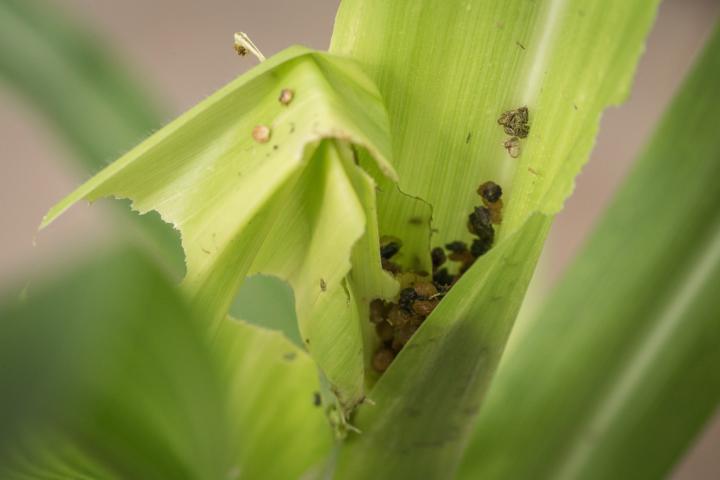
Fall armyworm larvae are voracious feeders on leaves in the confined whorls of corn plants, and by necessity the insects defecate nearby in the crevasses where the leaves meet the stalks. Copious amounts of frass accumulate in these structures and can remain there for a long period of time.

"It would be disadvantageous for the insect to deposit cues that could enhance plant defenses against it, so we investigated what chemical compounds in the frass were signaling the plant," said Dawn Luthe, professor of plant stress biology.

"It turns out that the caterpillar frass tricks the plant into sensing that it is being attacked by fungal pathogens and mounting a defense against them, thereby suppressing the plant's defenses against herbivores. Plants cannot defend against both pathogens and insect attackers simultaneously -- they must switch on either their pathway to defend against herbivores or their pathway to defend against pathogens."

The research, recently published in the Journal of Chemical Ecology, may lead to the isolation of specific components of the frass that can be incorporated into a compound to be sprayed on crops. Such an organic, ecologically sustainable pesticide could enhance plant defenses against pathogens, Luthe said. Or perhaps plants may be genetically modified to incorporate the proteins from the frass to boost a crop's native resistance to pathogens.

Caterpillar frass is composed of molecules derived from the host plant, the insect itself and associated microbes, and hence it provides abundant cues that may alter plant defense responses, explained lead researcher Swayamjit Ray, who is a doctoral student in the intercollege Plant Biology program at Penn State. He pointed out that proteins from fall armyworm caterpillar frass initially induced wound-responsive defense genes in corn; however, a pathogenesis-related defense gene was induced shortly after.

The elicitation of pathogen defenses by frass proteins was correlated with increased herbivore growth and reduced fungal pathogen prevalence over time, the researchers report. These responses differ from the typical plant response to oral secretions of the fall armyworm caterpillar, and the results pave the way for identification of a protein molecule from the excretion of an herbivore that elicits pathogen-defense responses while suppressing herbivore defenses in plants.

To test their hypothesis, researchers applied frass extract to the leaves of corn plants and compared the growth of fall armyworm caterpillars that fed on the leaves to the growth of caterpillars that fed on untreated leaves. They also measured the performance of a fungal pathogen in response to frass treatment of corn leaves. They inoculated the leaves with spores of a fungus that causes leaf blight in corn (Cochliobolus heterostrophus).

"The plant perceives that it is being attacked by a pathogen and not an insect, so it turns on its defenses against pathogens, leaving the caterpillar free to continue feeding on the plant. It is an ecological strategy that has been perfected over thousands of years of evolution," Ray said.

Friday, August 28, 2015

Essentials to Consider in Landscape Design


There are at least four essentials to consider in creating a landscape design: aesthetics, function, balance, and sustainability. All four essentials are harmonized to achieve a landscape design that is cohesive and beautiful.

Aesthetics
Let’s face it. When people have their property landscaped, they assume it will project a sense of beauty in its own unique way. The flowers should be lovely and stunning, the trees majestic or sheltering, the pergolas romantic, and the pond or fountain or statue should be breathtaking. The overall effect is expected to elicit an exclamation of delight.

This is why it is important to thoughtfully and carefully select each flowering plant, each tree, each set of garden furniture or garden décor for your landscape design. They should not be chosen simply on a whim but by careful preparation and consideration. A beautiful landscape design is not created overnight. It takes careful planning.

When people look at a landscape, they should see harmony between all choice elements. For example, does the gazebo lend an aura of romance to the landscape design or does it ruin it by looking contrived or out of place? Most landscapers advise to think of the landscape like a house having many rooms. Each room should smoothly blend or flow into the next.

Function
As much as possible each landscape design element shouldn’t simply “stand there just looking pretty.” The group of plants, set of flowers, rows of shrubs or trees must serve a function. As should the pond, statues, urns and other garden décor. Are the trees for shade or for fencing? Is the fountain somehow connected to an irrigation system? Of course, the bamboo bench under the pergola provides a place to relax.

Balance
Behind all the beauty and functionality is balance. A good landscape design must have balance. This involves not only the obvious ones such as the complementary colors of blooms and greenery or the symmetry of the garden furniture or stone paths. Each one should be positioned in the landscape so as to contribute to the healthy existence of the others.

Sustainability
With all the plants, trees, garden décor, outdoor furniture, pond or fountain that you plan to include in your landscape design, you must consider sustainability. Simply put, will you be able to maintain the whole thing? Will you be able to keep it together as the seasons change?

Tuesday, August 11, 2015

Rare Plants Take Root, Bloom in Chicago This Summer


It's an exciting time for nature lovers. The world's largest flower, titan arum – known as the corpse flower thanks to its notoriously horrible odor – is about to bloom for the first time ever in the Chicago area.

Over at Montrose Beach, a rare carnivorous plant has taken root. Not to worry: It's still safe to go to the beach. The great bladderwort (Utricularia macrorhiza) isn't a man-eating plant, it feeds on insects and larvae, much like the swarms of dragonflies we've been seeing on the lakefront this summer.

Here to help us dig deeper into Mother Nature's mysteries are Tim Pollak, outdoor floriculturist at the Chicago Botanic Garden; Greg Spyreas, a botanist with the Illinois Natural History Survey, an ecological research institute based in Champaign; and biologist Doug Taron, Vice President of Research and Conservation at the Peggy Notebaert Nature Museum.

Titan arum

Commonly known as the corpse flower for its signature scent – reminiscent of rotting meat – a titan arum named Spike has been on public display at the Chicago Botanic Garden since Aug. 6.

Spike is expected to bloom at any moment, and the garden plans to celebrate its arrival by staying open until 2:00 am so as many visitors as possible can see – and smell – the impressive plant.

Expect to see a spike that will be 6-8 feet tall, skirted by a huge, maroon flower at its base. The frilly bloom will close about 24 hours later, so plan accordingly if this is on your bucket list. It could be years before a titan arum blooms again at the botanic garden. In fact, Spike's big day has been 12 years in the making.

Greater bladderwort


On Monday, Chicago Tonight reported that a carnivorous plant had been discovered at Montrose Beach Dunes. The tiny plant (Utricularia macrorhiza) topped with bright yellow flowers preys on water fleas, zoo plankton, and other small aquatic insects. (So, no need to cover your toes the next time you're out for a stroll.) The finding is scientifically important because, although the plant has been seen in the Chicago area, it hadn't been identified at the Montrose Beach Dunes until Aug. 1.

Interestingly, the plant doesn't operate in the classic Venus flytrap style of Little Shop of Horrors. Instead, the action takes place under water, where tiny hairs covering bladder-like pouches serve as mechanisms for catching prey. An aquatic insect swims by, triggering the hairs, which in turn release water from the pouches. When the water rushes back into the pouches, a vacuum is created, catching the insect.

Friday, July 17, 2015

Create A Beautiful Landscape In Your Backyard For Summer This Year


The landscape of your house speaks volumes about you and your lifestyle. Planning one’s landscape is not a child’s play; one has to take several things into consideration. With increasing craze for landscaping, Landscape Architecture Toronto is going through a wave of change and innovative designs have become an order of the day.

In the initial stage, I consider your choice and requirements after which, they study the area available and think of all possible ways and styles that would suit you in the most appropriate manner. The designers and gardeners who are proficient in this field help you in making your landscape more scenic and remarkable within the budget that you have set for this purpose. Budget is an important element in this respect as it determines the level of designing.

The selection of plants, shrubs or trees, to a very great extent, depends upon your individual choice but mostly the combination is decided considering their shape, size, balance and texture. Other items like canopies, stony set-ups and fences should be carefully planned. Your design should contain all your important requirements like service area, seasonal appeal, lower maintenance and a blissful assortment of colorful flowering and non flowering plants along with other garden accessories.


After a thorough analysis of the location, an ultra illustrative sketch or model is created with full colors specifications so that you can visualize your landscape as it will appear after completion. Though you should have a great variety of designs to offer yet you must make an initiative to suggest the design of your choice for maximum contentment.

Once you are satisfied with the layout, it will give you a price quotation for the project and thereby decide upon the schedule for the construction with reference to the time line finalized by you. Hence with the help of their expert designers and workforce, they will make your landscape a delight to watch for everybody including your family, neighbors and guests, who will never be able to resist complimenting you.

So whether it is your home’s front yard or backyard, you can spread the magic of your creativity on the land in a unique way.

Friday, July 3, 2015

Factor To Think About While Landscape Designs A Flower Garden


Flowers are wonderful landscape designs factors that can rapidly help make your landscape designs garden wealthy with colors and excitement. Another benefit of the flowering garden is they attract wild birds and seeing stars to function extra existence to your garden.

While considering landscape designs a flower garden there are many options at the hands. I've attempted to classify the flowering garden into various groups. Let us take a look their way 1 by 1.

1) The kind of flower garden

The best idea type of planting you want to see inside your garden. Here are the options.

Flowerbed - This is actually the most typical and popular type of using flowers inside a garden. Due to the fact a flowerbed can be used an border aspect in an outdoor. for those who have a flowerbed it will save you the price of creating fencing

Container flowering - Because the title indicates this process uses small dimensions flowering plants that are simple to maintain ad may be used indoor too. Another utilization of container is they could be hanged inside a window or perhaps a balcony.

Ground covers - A flowering plant that covers and propagates flat is among the most breathtaking kinds of flower gardening. This can be on the hillside landscape designs site with achievement.

2) The kind species based on the colour of flowers

The main reason you'll need a flower garden may be the colorful display they present after completion. Here are a few options.

Single color - Apply for just one kind of species on your garden with single colored flowers

Multicolor - With multicolor flower you've two options. Planting different species with various colors or versions of merely one plant with various colored flowers

Shaded - Some flowers possess a mixtures of shades within their flower petals. This really is a different way to start variety inside your garden.

Perfumed - A great advantage inside a flowering garden. Some flowers have excellent scent that may energize the nearby atmosphere simply by their presence.

These are merely a couple of groups to search for while selecting plants for landscape designs a flower garden. Home theater system . will develop more great suggestions for your flower garden.