Tips

Many kinds of flower are collected Here, Besides, do you need flower in your wedding or match with your ball dresses nz?

Monday, July 11, 2016

Country diary: Elder flowers fill our hedgerows with sweet scent


“The cuckoo comes in April, He sings his song in May, And then in June he changes tune, In July he flies away.”

It’s time to go – and we haven’t heard a single cuckoo this year. It’s sad that so many migrant birds are vanishing. I believe their numbers have been reduced by 50 per cent over the last 20 years.

Cuckoo spit has nothing to do with cuckoos. It’s the little frothy balls found on grasses etc in summertime that serves a useful purpose. The foam is produced by the nymphs of bugs which are called frog hoppers – because they jump, probably to protect themselves against dessication. The froth is produced by discharging air through a valve in the abdomen. This mixes with liquid issuing from the anus, and is often abundant on plants. If you poke inside the foam, you’ll find the tiny occupant.

A highlight this week was the viewing of a pair of jays at close quarters, in Forge Valley’s bird feeding station. With four gray squirrels occupying bird tables, a handsome jay descended, and hungrily devoured food scattered at the foot of the fence. Jays are usually secretive and wary, first heard by their loud, raucous calls before flying away. This bird remained from about 4pm to 4.20pm, and its pinkish-brown body, and white and blue wing patches were unmistakable. It was joined by its mate before flying into woodland, when the white rump and black tail were very conspicuous. Jays eat a wide variety of foods, but acorns are the most important. They’re responsible for the massive dispersal of acorns in the autumn.

Tigga led us up a damp, woodland path on the fringe of East Ayton near Scarborough. Although most flowers were now seeding, for a local orchid it was the peak time for blooming. The common twayblade is an unobtrusive plant, but very distinct in having only two leaves on its erect stem. These leaves give the plant its name. ‘Tway’ is an old form of two, and ‘blade’ refers to the leaf. The flowers are small and greenish with large numbers clustered in a spike. A single pair of large oval leaves are towards the bottom of the stem.

The meadows are now aglow with buttercups, and beside meres and marshy areas, the stately wild yellow irises flourish. The wild iris can’t be mistaken, as the flowers are like those of the garden iris, but yellow in colour.

In the hedgerows, gone are the ‘waves’ of hawthorn blossom that gladdened the heart in springtime. The berries, in their turn, are ripening. Watch the small bunches mature into round, dark red berries.

Now the elder bushes reign supreme in the hedgerows. Throughout June the shrubs have become covered with great sprays of sweet-smelling flowers with many uses. They even have an acknowledged role as an ingredient in skin ointments and eye lotions.

I love the creamy-white, frothy clusters of elder flowers, and must confess to munching them straight off the branch on a hot summer’s day. They’re so cool and refreshing.

There are many time-consuming recipes, but try making this simple drink. Put a bunch of elder flowers in a jug, stalks and all. Pour on boiling water, and leave until cool. Strain the liquid off and sweeten to taste. Do check that the flowers are insect free, but never wash the flowers, as this removes much of their fragrance. Enjoy!

Tuesday, December 8, 2015

Snowberry glistens


There are more berries than usual on snowberry plants this year. The flowers are tiny, pink in colour and hardly noticeable tucked away amid the leaves in summer. Nor are the berries very visible either until the last of the leaves fall, which happened in the last couple of weeks. The last few yellow leaves can look very attractive along with the pearl-like berries.

While the shrub is well known and grows all over the country, it would appear to be native but it is not. It is native to the western coastal states of North America. Planted originally as cover for pheasants it has found its way into hedges and woodlands. This shrub suckers readily at the roots and spreads outwards to make a broad thicket several metres across. It could keep on spreading but it tends to run into an obstacle, such as a large tree or heavy shade. It has been known to get under garden walls, its root suckers passing under the foundations. It looks well under tall trees as a kind of groundcover but this ordinary kind is generally too vigorous for gardens and it is likely that many stands of it originated as garden discards.

The ordinary snowberry is the one seen growing semi-wild. There are other kinds that are better behaved.

'Mother of Pearl' has a drooping habit and white berries with a pink flush. 'White Hedge' has a compact growth habit and is upright with white fruits. 'Hancock' is low and spreading, often rooting where it touches the soil, and it has pink berries. 'Magic Berry' is low and bushy with rose-pink berries.

Although it tolerates light shade very well, the shrub produces more berries if grown in sunshine, at least for part of the day. It can look very pretty dotted with white berries caught in the winter light against a shaded background.

In a shady place, the foliage takes on a lovely softness, almost flimsy in appearance. The plant grows in any kind of soil that is not waterlogged but thrives best in well-drained leafy soil such as that found in woodland, similar to its natural habitat.

Is my cyclamen rotting in wet compost?

"I planted winter pansies, violas, mini-cyclamen and cyclamen in my window boxes in late September. The compost is very wet and the cyclamen may be rotting. I have deadheaded but little further flowering has occurred. Do I need to dry out window boxes and if so how? Also, should I fertilise to encourage growth and if so, with what type of product?" Yvonne, Co Louth

While mini-cyclamen can be grown outdoors, the large-flowered cyclamen is not an outdoor plant as it needs a cool room indoors. Growth is running down now. Ensure that drainage from the boxes is working and that there is no undue drip from the roof or gutters. No feeding is necessary now, but you could liquid feed in early spring as growth picks up.

Sunday, September 27, 2015

Thank you, Land of the Long white cloud


Ireland's record against the giants of world rugby is not good (played 28, lost 27 drawn 1) so I got to thinking, what have the New Zealanders ever done for us? Well in terms of our gardens quite a lot actually, and very glad about it I am too.

80% of New Zealand's native flora is endemic, that is to say found naturally nowhere else. From this amazing fact it sound like these plants are shy species, rarely seen. Think again because I can guarantee that you see some these plants everyday. Through squinted eyes Ireland and New Zealand are really quite similar in looks and weather conditions despite being half a world apart. No surprise then that many of their exports do so well here.

Griselinia littoralis must make up 50% of all the hedges planted in Ireland. Massively sucessful, effective, easily grown and evergeen. Few plants make a better hedge but I prefer this plant grown as a large shrub. Left unpruned it will grow to four metres or more and makes a magnificent high screen. Large specimens can be found in the west of Ireland in some of the older gardens where they were planted as individuals before their hedging epidemic caught on. Griselinia 'Variegata' has white/cream through the green leaves and is a very effective contrast and winter plant.

Cordyline australis [Cabbage palm] despite its name comes from New Zealand. This is the spikey palm tree conspicuous in so many front gardens around the country. Its constant foliage rustle tells you it's in the vicinity before you've even see it. As does the fragrance from the huge clusters of sweetly scented summer flowers .

Phormium, helpfully named New Zealand flax, is another plant that resides in many Irish gardens. Like a lot of New Zealand plants it is very effective in coastal areas. Many cultivars or named varieties have been raised from the two species P. tenax and P. cookianum and as hybrids between the two. All have sword like foliage in colours of pink, red, purple, cream and yellow.

Pittosporum tenuifolium and its many variegated cultivars are also common to our gardens. Their dainty evergreen foliage is great for flower arranging and lovely as a soft contrasting plant in borders. Pittosporums are useful as large evergreen screening plants as is Hoheria sexstylosa with a narrow foliage and a profusion of white flowers in August. Olearia macrodonata [New Zealand holly] also falls into this category having glaucous holly like leaves and daisy flowers.

Leptospermum scoparium apart from being a beautiful flowering garden shrub is also the source of the well known manuka honey that's is supposed to have so many health benefits. Garden cultivars include 'Pink Cascade' , Red Damask' and 'Snow White'

The vast majority of Hebes started of life in New Zealand although today they have been so cultivated their ancestors have been forgotten. Dodonaea viscosa 'Purpurea' is a much under used soft purple foliaged evergreen giving lovely movement in a planting scheme. Astelia chathamica, Sophora microphylus, Clianthus puniceus, Libertia x grandiflora, Myosotidium hortensia. The list, as they say, literally goes on.

Thursday, September 10, 2015

Caterpillar deceives corn plant into lowering defenses against it


In a deception that likely has evolved over thousands of years, a caterpillar that feeds on corn leaves induces the plant to turn off its defenses against insect predators, allowing the caterpillar to eat more and grow faster, according to chemical ecologists in Penn State's College of Agricultural Sciences.

The finding is one more revelation about the myriad of chemical signals that pass between plants and insects that scientists at Penn State and around the world have been discovering in recent years. In this case, the agent of deceit is the caterpillar's feces, or "frass."

Plants are under constant threat of attack from herbivorous insects. Nearly 400,000 plant-eating insect species are known to live on 300,000 plant species. When these herbivores feed on plants, they not only cause mechanical damage but often deposit substances that can manipulate the plant's response to herbivory. These substances are analogous to the microbial-associated compounds that affect plant responses to pathogenic fungi or bacteria.

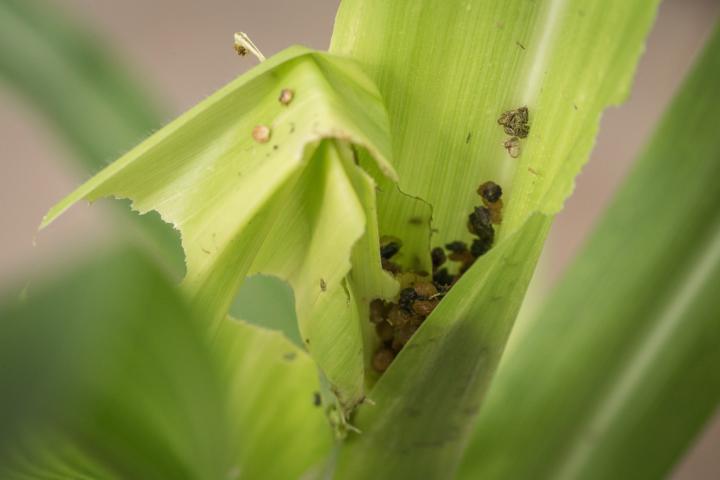
Fall armyworm larvae are voracious feeders on leaves in the confined whorls of corn plants, and by necessity the insects defecate nearby in the crevasses where the leaves meet the stalks. Copious amounts of frass accumulate in these structures and can remain there for a long period of time.

"It would be disadvantageous for the insect to deposit cues that could enhance plant defenses against it, so we investigated what chemical compounds in the frass were signaling the plant," said Dawn Luthe, professor of plant stress biology.

"It turns out that the caterpillar frass tricks the plant into sensing that it is being attacked by fungal pathogens and mounting a defense against them, thereby suppressing the plant's defenses against herbivores. Plants cannot defend against both pathogens and insect attackers simultaneously -- they must switch on either their pathway to defend against herbivores or their pathway to defend against pathogens."

The research, recently published in the Journal of Chemical Ecology, may lead to the isolation of specific components of the frass that can be incorporated into a compound to be sprayed on crops. Such an organic, ecologically sustainable pesticide could enhance plant defenses against pathogens, Luthe said. Or perhaps plants may be genetically modified to incorporate the proteins from the frass to boost a crop's native resistance to pathogens.

Caterpillar frass is composed of molecules derived from the host plant, the insect itself and associated microbes, and hence it provides abundant cues that may alter plant defense responses, explained lead researcher Swayamjit Ray, who is a doctoral student in the intercollege Plant Biology program at Penn State. He pointed out that proteins from fall armyworm caterpillar frass initially induced wound-responsive defense genes in corn; however, a pathogenesis-related defense gene was induced shortly after.

The elicitation of pathogen defenses by frass proteins was correlated with increased herbivore growth and reduced fungal pathogen prevalence over time, the researchers report. These responses differ from the typical plant response to oral secretions of the fall armyworm caterpillar, and the results pave the way for identification of a protein molecule from the excretion of an herbivore that elicits pathogen-defense responses while suppressing herbivore defenses in plants.

To test their hypothesis, researchers applied frass extract to the leaves of corn plants and compared the growth of fall armyworm caterpillars that fed on the leaves to the growth of caterpillars that fed on untreated leaves. They also measured the performance of a fungal pathogen in response to frass treatment of corn leaves. They inoculated the leaves with spores of a fungus that causes leaf blight in corn (Cochliobolus heterostrophus).

"The plant perceives that it is being attacked by a pathogen and not an insect, so it turns on its defenses against pathogens, leaving the caterpillar free to continue feeding on the plant. It is an ecological strategy that has been perfected over thousands of years of evolution," Ray said.