Plants also the peoples' friends, we must take care them!
Tips
Many kinds of flower are collected Here, Besides, do you need flower in your wedding or match with your ball dresses nz?
Sunday, September 27, 2015
Thank you, Land of the Long white cloud
Ireland's record against the giants of world rugby is not good (played 28, lost 27 drawn 1) so I got to thinking, what have the New Zealanders ever done for us? Well in terms of our gardens quite a lot actually, and very glad about it I am too.
80% of New Zealand's native flora is endemic, that is to say found naturally nowhere else. From this amazing fact it sound like these plants are shy species, rarely seen. Think again because I can guarantee that you see some these plants everyday. Through squinted eyes Ireland and New Zealand are really quite similar in looks and weather conditions despite being half a world apart. No surprise then that many of their exports do so well here.
Griselinia littoralis must make up 50% of all the hedges planted in Ireland. Massively sucessful, effective, easily grown and evergeen. Few plants make a better hedge but I prefer this plant grown as a large shrub. Left unpruned it will grow to four metres or more and makes a magnificent high screen. Large specimens can be found in the west of Ireland in some of the older gardens where they were planted as individuals before their hedging epidemic caught on. Griselinia 'Variegata' has white/cream through the green leaves and is a very effective contrast and winter plant.
Cordyline australis [Cabbage palm] despite its name comes from New Zealand. This is the spikey palm tree conspicuous in so many front gardens around the country. Its constant foliage rustle tells you it's in the vicinity before you've even see it. As does the fragrance from the huge clusters of sweetly scented summer flowers .
Phormium, helpfully named New Zealand flax, is another plant that resides in many Irish gardens. Like a lot of New Zealand plants it is very effective in coastal areas. Many cultivars or named varieties have been raised from the two species P. tenax and P. cookianum and as hybrids between the two. All have sword like foliage in colours of pink, red, purple, cream and yellow.
Pittosporum tenuifolium and its many variegated cultivars are also common to our gardens. Their dainty evergreen foliage is great for flower arranging and lovely as a soft contrasting plant in borders. Pittosporums are useful as large evergreen screening plants as is Hoheria sexstylosa with a narrow foliage and a profusion of white flowers in August. Olearia macrodonata [New Zealand holly] also falls into this category having glaucous holly like leaves and daisy flowers.
Leptospermum scoparium apart from being a beautiful flowering garden shrub is also the source of the well known manuka honey that's is supposed to have so many health benefits. Garden cultivars include 'Pink Cascade' , Red Damask' and 'Snow White'
The vast majority of Hebes started of life in New Zealand although today they have been so cultivated their ancestors have been forgotten. Dodonaea viscosa 'Purpurea' is a much under used soft purple foliaged evergreen giving lovely movement in a planting scheme. Astelia chathamica, Sophora microphylus, Clianthus puniceus, Libertia x grandiflora, Myosotidium hortensia. The list, as they say, literally goes on.
Thursday, September 10, 2015
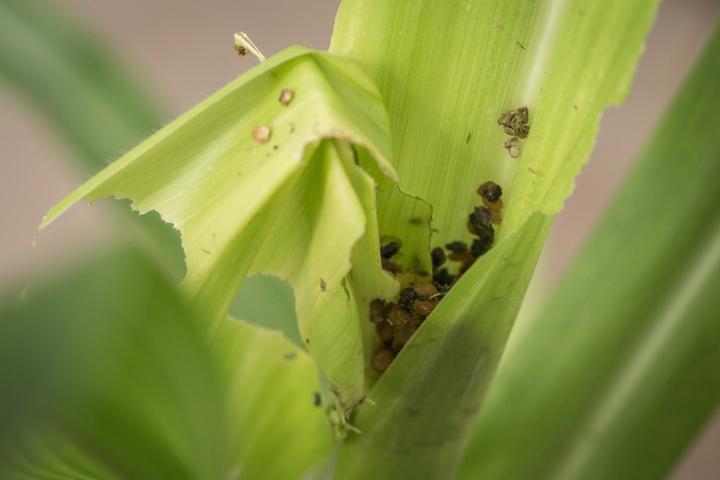
Caterpillar deceives corn plant into lowering defenses against it
In a deception that likely has evolved over thousands of years, a caterpillar that feeds on corn leaves induces the plant to turn off its defenses against insect predators, allowing the caterpillar to eat more and grow faster, according to chemical ecologists in Penn State's College of Agricultural Sciences.
The finding is one more revelation about the myriad of chemical signals that pass between plants and insects that scientists at Penn State and around the world have been discovering in recent years. In this case, the agent of deceit is the caterpillar's feces, or "frass."
Plants are under constant threat of attack from herbivorous insects. Nearly 400,000 plant-eating insect species are known to live on 300,000 plant species. When these herbivores feed on plants, they not only cause mechanical damage but often deposit substances that can manipulate the plant's response to herbivory. These substances are analogous to the microbial-associated compounds that affect plant responses to pathogenic fungi or bacteria.
Fall armyworm larvae are voracious feeders on leaves in the confined whorls of corn plants, and by necessity the insects defecate nearby in the crevasses where the leaves meet the stalks. Copious amounts of frass accumulate in these structures and can remain there for a long period of time.
"It would be disadvantageous for the insect to deposit cues that could enhance plant defenses against it, so we investigated what chemical compounds in the frass were signaling the plant," said Dawn Luthe, professor of plant stress biology.
"It turns out that the caterpillar frass tricks the plant into sensing that it is being attacked by fungal pathogens and mounting a defense against them, thereby suppressing the plant's defenses against herbivores. Plants cannot defend against both pathogens and insect attackers simultaneously -- they must switch on either their pathway to defend against herbivores or their pathway to defend against pathogens."
The research, recently published in the Journal of Chemical Ecology, may lead to the isolation of specific components of the frass that can be incorporated into a compound to be sprayed on crops. Such an organic, ecologically sustainable pesticide could enhance plant defenses against pathogens, Luthe said. Or perhaps plants may be genetically modified to incorporate the proteins from the frass to boost a crop's native resistance to pathogens.
Caterpillar frass is composed of molecules derived from the host plant, the insect itself and associated microbes, and hence it provides abundant cues that may alter plant defense responses, explained lead researcher Swayamjit Ray, who is a doctoral student in the intercollege Plant Biology program at Penn State. He pointed out that proteins from fall armyworm caterpillar frass initially induced wound-responsive defense genes in corn; however, a pathogenesis-related defense gene was induced shortly after.
The elicitation of pathogen defenses by frass proteins was correlated with increased herbivore growth and reduced fungal pathogen prevalence over time, the researchers report. These responses differ from the typical plant response to oral secretions of the fall armyworm caterpillar, and the results pave the way for identification of a protein molecule from the excretion of an herbivore that elicits pathogen-defense responses while suppressing herbivore defenses in plants.
To test their hypothesis, researchers applied frass extract to the leaves of corn plants and compared the growth of fall armyworm caterpillars that fed on the leaves to the growth of caterpillars that fed on untreated leaves. They also measured the performance of a fungal pathogen in response to frass treatment of corn leaves. They inoculated the leaves with spores of a fungus that causes leaf blight in corn (Cochliobolus heterostrophus).
"The plant perceives that it is being attacked by a pathogen and not an insect, so it turns on its defenses against pathogens, leaving the caterpillar free to continue feeding on the plant. It is an ecological strategy that has been perfected over thousands of years of evolution," Ray said.
Friday, August 28, 2015
Essentials to Consider in Landscape Design
There are at least four essentials to consider in creating a landscape design: aesthetics, function, balance, and sustainability. All four essentials are harmonized to achieve a landscape design that is cohesive and beautiful.
Aesthetics
Let’s face it. When people have their property landscaped, they assume it will project a sense of beauty in its own unique way. The flowers should be lovely and stunning, the trees majestic or sheltering, the pergolas romantic, and the pond or fountain or statue should be breathtaking. The overall effect is expected to elicit an exclamation of delight.
This is why it is important to thoughtfully and carefully select each flowering plant, each tree, each set of garden furniture or garden décor for your landscape design. They should not be chosen simply on a whim but by careful preparation and consideration. A beautiful landscape design is not created overnight. It takes careful planning.
When people look at a landscape, they should see harmony between all choice elements. For example, does the gazebo lend an aura of romance to the landscape design or does it ruin it by looking contrived or out of place? Most landscapers advise to think of the landscape like a house having many rooms. Each room should smoothly blend or flow into the next.
Function
As much as possible each landscape design element shouldn’t simply “stand there just looking pretty.” The group of plants, set of flowers, rows of shrubs or trees must serve a function. As should the pond, statues, urns and other garden décor. Are the trees for shade or for fencing? Is the fountain somehow connected to an irrigation system? Of course, the bamboo bench under the pergola provides a place to relax.
Balance
Behind all the beauty and functionality is balance. A good landscape design must have balance. This involves not only the obvious ones such as the complementary colors of blooms and greenery or the symmetry of the garden furniture or stone paths. Each one should be positioned in the landscape so as to contribute to the healthy existence of the others.
Sustainability
With all the plants, trees, garden décor, outdoor furniture, pond or fountain that you plan to include in your landscape design, you must consider sustainability. Simply put, will you be able to maintain the whole thing? Will you be able to keep it together as the seasons change?
Tuesday, August 11, 2015
Rare Plants Take Root, Bloom in Chicago This Summer
It's an exciting time for nature lovers. The world's largest flower, titan arum – known as the corpse flower thanks to its notoriously horrible odor – is about to bloom for the first time ever in the Chicago area.
Over at Montrose Beach, a rare carnivorous plant has taken root. Not to worry: It's still safe to go to the beach. The great bladderwort (Utricularia macrorhiza) isn't a man-eating plant, it feeds on insects and larvae, much like the swarms of dragonflies we've been seeing on the lakefront this summer.
Here to help us dig deeper into Mother Nature's mysteries are Tim Pollak, outdoor floriculturist at the Chicago Botanic Garden; Greg Spyreas, a botanist with the Illinois Natural History Survey, an ecological research institute based in Champaign; and biologist Doug Taron, Vice President of Research and Conservation at the Peggy Notebaert Nature Museum.
Titan arum
Commonly known as the corpse flower for its signature scent – reminiscent of rotting meat – a titan arum named Spike has been on public display at the Chicago Botanic Garden since Aug. 6.
Spike is expected to bloom at any moment, and the garden plans to celebrate its arrival by staying open until 2:00 am so as many visitors as possible can see – and smell – the impressive plant.
Expect to see a spike that will be 6-8 feet tall, skirted by a huge, maroon flower at its base. The frilly bloom will close about 24 hours later, so plan accordingly if this is on your bucket list. It could be years before a titan arum blooms again at the botanic garden. In fact, Spike's big day has been 12 years in the making.
Greater bladderwort
On Monday, Chicago Tonight reported that a carnivorous plant had been discovered at Montrose Beach Dunes. The tiny plant (Utricularia macrorhiza) topped with bright yellow flowers preys on water fleas, zoo plankton, and other small aquatic insects. (So, no need to cover your toes the next time you're out for a stroll.) The finding is scientifically important because, although the plant has been seen in the Chicago area, it hadn't been identified at the Montrose Beach Dunes until Aug. 1.
Interestingly, the plant doesn't operate in the classic Venus flytrap style of Little Shop of Horrors. Instead, the action takes place under water, where tiny hairs covering bladder-like pouches serve as mechanisms for catching prey. An aquatic insect swims by, triggering the hairs, which in turn release water from the pouches. When the water rushes back into the pouches, a vacuum is created, catching the insect.
Subscribe to:
Posts (Atom)